
The Real Disclosure
The conversation beneath the conversation may not be extraterrestrial after all

Every age has its forbidden conversations.
There was a time when speaking of invisible forces acting at a distance sounded ridiculous. Then came gravity.
There was a time when continents were thought immovable. Then they drifted.
There was a time when invisible organisms causing disease belonged to the realm of superstition. Then we learned to see them.
History has a habit of making fools of certainty.
Now another conversation is escaping the margins.
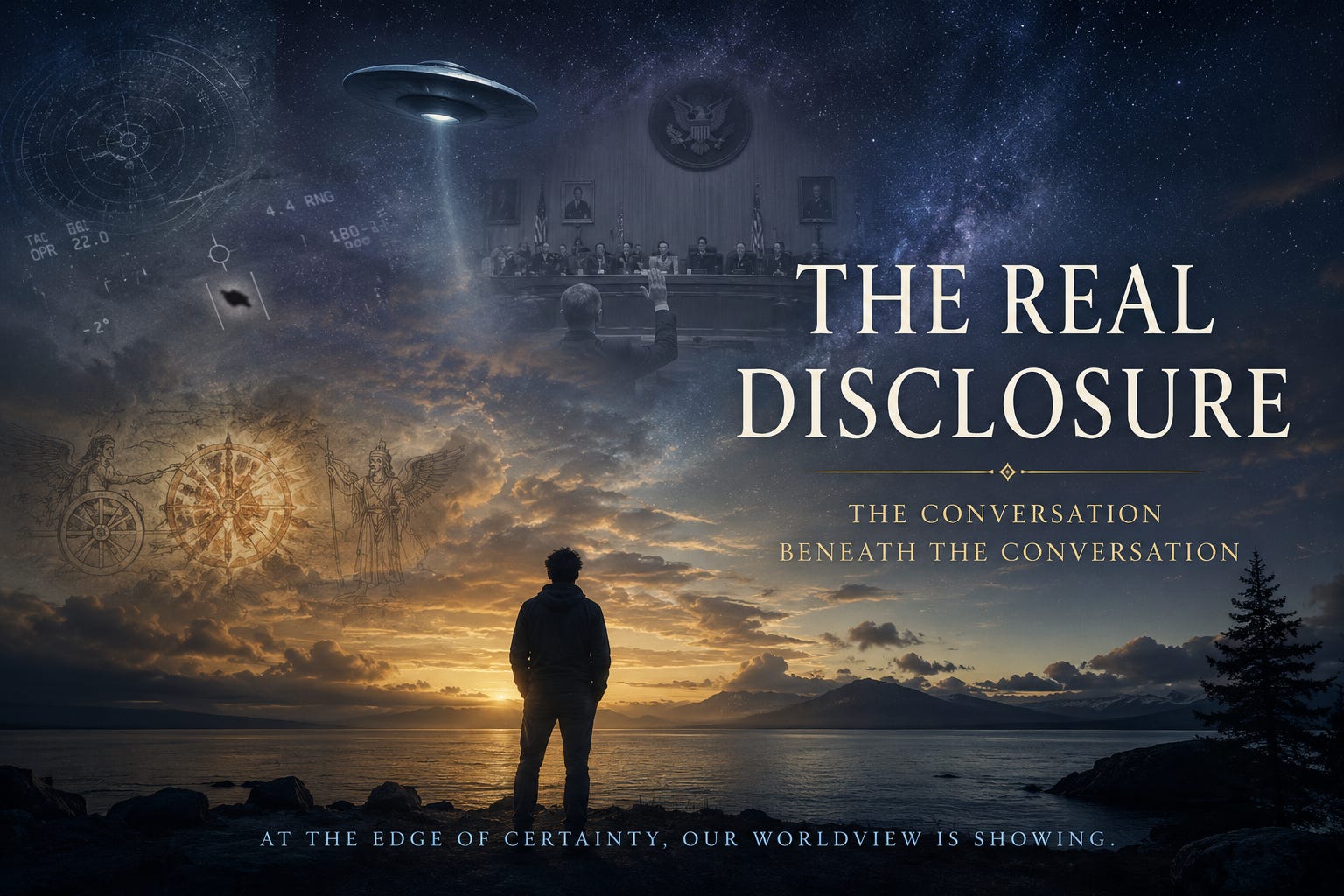
Congress holds hearings. Military pilots give testimony. Radar tracks are released. Whistleblowers speak of secret programs. Governments, after decades of dismissal, quietly acknowledge that there are objects moving through our airspace that they cannot explain.
The discussion has become strangely polarized.
Some have already decided that extraterrestrial civilizations are visiting the earth.
Others have already decided that the entire subject is nonsense.
I find myself in neither camp.
I am both a skeptic and an experiencer.
That combination is less contradictory than it sounds.
Skepticism is not the refusal to believe. It is the refusal to surrender judgment too quickly.
Experience is not proof. It is simply the recognition that there are moments in life that do not fit neatly into the boxes we inherited.
The older I get, the less interested I become in winning arguments and the more interested I become in understanding what kind of world would make certain experiences possible.
That, I think, is the deeper question emerging beneath the current wave of disclosure.
Not:
Are aliens real?
But:
What kind of reality are we living in?
I suspect that the most important disclosure taking place right now is not the disclosure of extraterrestrial intelligence.
It is the disclosure of our worldview.
Some people fear that if humanity discovered it was not alone, civilization would unravel. Faith would collapse. Meaning would evaporate. The old stories would fail us.
Perhaps.
But perhaps the opposite is true.
As I read the old stories, they have always been larger than we imagined.
Ancient people described strange encounters with the language they possessed. They spoke of angels and demons, fiery chariots, visions, powers and principalities, voices in the wilderness, burning bushes, wheels within wheels.
We describe unusual encounters with the language we possess. We speak of dimensions, simulations, quantum possibilities, artificial intelligence, extraterrestrials, and unidentified anomalous phenomena.
The vocabulary changes. The human encounter with mystery remains.
There is another possibility worth considering.
What if these conversations are not primarily about visitors from somewhere else?
What if they are about us? What if they reveal something about the way human beings create meaning?
A strange thing happens whenever astonishing claims appear.
One person says, “I knew it.”
Another says, “Impossible.”
The evidence has not changed.
The observers have.
Seeing has at least two layers.
The first is perception.
The second is interpretation.
We imagine that we simply look at the world.
But we never do.
We look through memory.
Through education.
Through fear.
Through hope.
Through politics.
Through religion.
Through stories handed down by parents and cultures and civilizations.
We do not merely see the world. We meet it. And, in that meeting, a reality takes shape. That is why —besides all the other obvious reasons—the current conversation fascinates me. Not because I think I know what these phenomena are.
I do not.
Not because I trust governments. That would be a hard, no.
But to be balanced, nor do I blindly distrust governments. That would simply be another form of certainty.
The fascination lies elsewhere.
It lies in watching an entire civilization approach the edge of what it can explain.
Edges matter.
At the edge of maps, ancient cartographers drew sea monsters.
At the edge of knowledge, scientists discover new worlds.
At the edge of certainty, philosophers become poets.
And at the edge of reality itself, perhaps we rediscover humility.
And humility may be the rarest virtue of our age.
I think life rewards that posture more often than certainty. Because the world has changed before. The ground has moved before. And when it does, perhaps the task is not to cling more tightly to old maps or to abandon maps altogether.
Perhaps the task is simply to learn how to see.
And if we learn how to see, we may discover that the greatest mystery was never whether we are alone in the universe.
The greatest mystery is that we can perceive a universe that has always been stranger, deeper, and more alive than we imagined.
Alex
My Books: