
The Future Emerges Through Relationship
Why attention, alignment, and responsibility shape what comes next

The future does not exist before it is created.
We often speak as if it does—as if it were already waiting somewhere ahead of us, intact and inevitable. We imagine time as a corridor and the future as a room we will eventually enter.
But that is not how futures come into being.
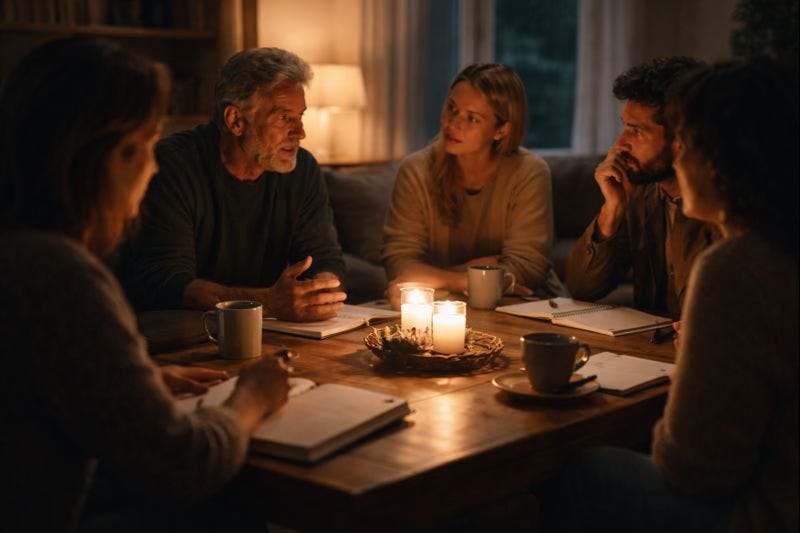
Before it exists, the future is not a thing at all. It is a possibility. And possibilities do not emerge in isolation. They emerge through relationship.
The emergence of the future is a relational emergence.
It takes shape through an ongoing exchange between attention and reality, between desire and constraint, between what we hope for and what is actually the case. It is not produced by force alone, and it is not revealed by waiting alone. It is formed through participation.
This is why effort so often fails to produce real change. We act as if action itself were creative, as if movement alone would eventually become direction. But action without attention is blind. It reacts rather than responds. It multiplies motion without altering course.
Creation begins with attention.
Attention is not strategy. It is not scanning for advantage. It is the willingness to stay with a question long enough for it to clarify. Attention asks what we actually want, beneath habit and expectation, and what is quietly trying to take shape through us.
Attention, however, is not enough on its own. It must meet alignment.
Alignment asks what is true now. It looks honestly at limits, responsibilities, and conditions that cannot be wished away. Alignment is not resignation. It is cooperation with reality as it is.
Only then does action make sense.
Action, in this frame, is rarely dramatic. It is provisional. It is the next step that can be taken without pretending we know more than we do. It moves forward while remaining correctable.
And then attention returns—not as hesitation, but as orientation. We look again to see whether what is taking shape still corresponds to what we sensed at the beginning. We adjust not because we failed, but because the future is still emerging.
Even passivity is a way of relating.
Waiting is never neutral. How we wait matters. Avoiding responsibility or ignoring opportunity does not preserve the present; it participates in the emergence of less generous futures. Neglect and avoidance are not absences of choice. They are ways of consenting to outcomes we may later wish we had resisted.
I learned this slowly, and not through planning.
In 1997, I began writing a piece of fiction as a way of sitting with questions I did not yet know how to ask directly. My anxiety was never loud or expressive. It was quiet, internal, and persistent. Writing gave it somewhere to go.
It began with a single sentence. A single scene. I thought it might become a short story.
The scene involved a street child in Brazil. As I stayed with it, a question emerged almost on its own: how did he end up here?
That question did not demand an answer. It invited attention.
As I paid attention, other figures appeared. A world began to take shape. What I was writing no longer felt like something I was inventing so much as something I was entering into.
I wrote slowly, over years. Sometimes intensely, sometimes not at all. The story lived first in notebooks, then on a hard drive. For long stretches it seemed dormant, but it never disappeared. It remained quietly unfinished, present at the edges of my attention.
Eventually, I realized that the only honest way to relate to it was to complete it. Not because it needed to be shared, but because it needed to be finished. Completion was not about outcome. It was about alignment.
I did not do that alone. Friends read chapters. Editors offered correction. The story became clearer through relationship—through conversation, response, and care. Eventually I jumped into a small community of aligned writers and mentors. They didn’t push it forward so much as help hold it steady.
That kind of presence does something subtle but important. It stabilizes attention. It keeps a relationship from dissolving back into abstraction. The work remained real not only because I attended to it, but because others did too. What had lingered unresolved for years moved toward completion in weeks, not because I forced it, but because the work and my attention were no longer divided.
Looking back, it is clear to me now: I did not create that future by force. I stayed in relationship with something that kept asking for attention. What struck me afterward was not how long the writing had taken, but how quickly it finished once it finally had my full attention.
For years, the unfinished portion of the story had lived at the edge of my awareness. I thought about it often, but always indirectly. It occupied space in the background of my mind without ever fully entering the foreground.
When I finally decided to finish it, something changed. The work didn’t become easier, but it became denser. Actions that had once felt fragmented began to connect. Writing one scene clarified the next. Each step fed back into attention rather than draining it.
It was as if sustained attention didn’t just precede action—it altered its tempo.
Once the relationship became coherent, time itself seemed to compress.
The future of that book emerged through that relationship, one question at a time.
That experience taught me something I could not have learned any other way.
The future does not unfold according to a script. It responds. It responds to how closely we are paying attention and how honestly we are aligned with what is real.
This is why the future cannot simply be forced into existence. But neither does it arrive on its own. It must be co-created.
The quiet days at the end of the year make this visible. The old year loosens its grip. The new one has not yet taken hold. For a brief moment, there is space to notice what is present without immediately converting it into plans.
If we rush to fill that space with resolve, we miss the conversation. If we linger there without engagement, nothing is formed.
But if we remain relational—attentive, aligned, responsive—something real begins to emerge.
The future does not preexist us.
It emerges through relationship.